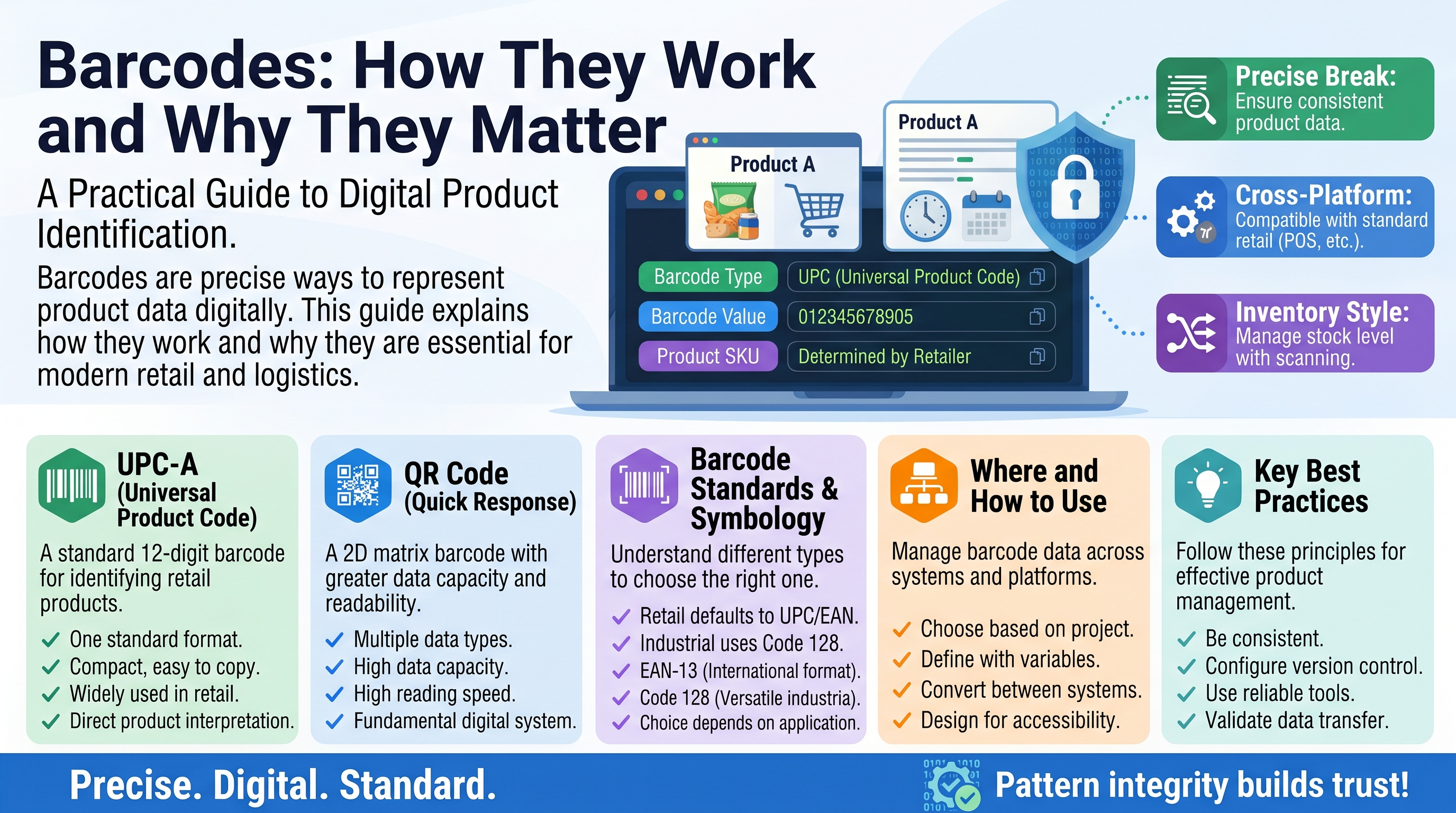
Barcodes: How They Work and Why They Matter
Look at almost any product in your home and you will find a barcode: those neat rows of black lines on a cereal box, the square QR code on a restaurant table, the striped label on a library book. We scan them without thinking, but barcodes are quietly one of the most successful data technologies ever deployed — trillions of scans happen every year, moving the entire global supply chain.
A barcode is simply a way of writing machine-readable data with printed marks. This guide explains how those lines encode information, how scanners read them, the main barcode types you will encounter, and why the humble barcode still matters in an age of RFID and NFC.
What a Barcode Actually Is
A barcode stores data in a visual pattern that an optical scanner can read far faster and more accurately than a human typing. The classic one-dimensional barcode encodes information in the widths of parallel bars and the spaces between them. A two-dimensional barcode, like a QR code, stores data in a grid of squares read both horizontally and vertically.
Every barcode represents the same basic idea: data made visible to machines. Instead of a cashier typing a twelve-digit product number — slowly and with inevitable typos — a scanner reads it in a fraction of a second with near-perfect accuracy. Industry studies put barcode scanning accuracy at roughly one error in several million scans, versus about one error per few hundred keystrokes for manual entry.
How a Barcode Scanner Reads Those Lines
A traditional laser scanner works on a beautifully simple principle: light and reflection. It sweeps a laser beam across the barcode. White spaces reflect the light back strongly; black bars absorb it. A light sensor converts that flickering reflection into an electrical signal — wide bars and narrow bars produce pulses of different durations — and a decoder translates the pulse pattern into digits or characters.
Modern camera-based scanners work differently but just as cleverly: they photograph the barcode and let software find the pattern, which is why your phone can read a wrinkled QR code on a curved coffee cup. Either way, two design features make the whole thing reliable:
- Quiet zones — the blank margins on both sides of the bars. Scanners need this empty space to know where the code starts and ends. A barcode printed too close to a box edge, with no quiet zone, simply will not scan.
- Start and stop patterns — special bar sequences marking the code's boundaries, so the scanner can read it in either direction. That is why cashiers can swipe items either way.
The Main Types of Barcodes
UPC-A: The Retail Standard
The Universal Product Code is the barcode on most products sold in North America: twelve digits encoding the manufacturer and the specific item. When you hear a beep at checkout, it is almost always a UPC being read. The scanner looks up the number in the store's database to find the price — the barcode itself contains no price, just an identifier.
EAN-13: The International Sibling
The European Article Number works the same way with thirteen digits and is the standard across most of the world. UPC and EAN are closely related; modern scanners read both effortlessly.
Code 39 and Code 128: The Industrial Workhorses
These barcodes encode full alphanumeric text, not just numbers. Code 39 appears on ID badges and inventory labels; the denser Code 128 is the backbone of shipping and logistics — the labels on parcels moving through warehouses worldwide are usually Code 128. If you have ever tracked a package, a Code 128 barcode did the real work at every sorting facility.
QR Codes and Data Matrix: Going Two-Dimensional
Two-dimensional barcodes store data in a grid instead of a line, packing in dramatically more information:
- QR codes can hold thousands of characters — URLs, contact cards, Wi-Fi credentials, payment addresses. They also include built-in error correction, so a QR code still scans with up to 30% of it damaged or obscured.
- Data Matrix codes are tiny and tough, etched directly onto electronics components, medical instruments, and aerospace parts where a label would never survive.
- PDF417 appears on boarding passes and government IDs, storing an entire record — name, photo data, document numbers — in one symbol.
The key difference: a 1D barcode is a lookup key (the data lives in a database), while a 2D barcode can carry the data itself.
Check Digits: The Built-In Error Detector
Most barcode standards include a check digit — a final digit calculated from all the others by a fixed formula, letting the scanner instantly verify it read the code correctly. Here is how the UPC check digit works:
Digits:   0  3  6  0  0  0  2  9  1  4  5  ?
Step 1: Sum digits in odd positions:  0+6+0+2+1+5 = 14
Step 2: Multiply by 3: 14 × 3 = 42
Step 3: Sum digits in even positions: 3+0+0+9+4 = 16
Step 4: Add: 42 + 16 = 58
Step 5: Check digit = (10 − (58 mod 10)) mod 10 = 2
If a smudge causes even one digit to misread, the check digit will not match and the scanner rejects the scan instead of ringing up the wrong product. This tiny piece of math is a big reason barcode systems are so trustworthy.
Barcodes in Everyday Life
Once you start noticing, barcodes run an astonishing range of systems:
- Retail checkout — UPC/EAN scanning made the modern supermarket possible; the first scanned product was a pack of Wrigley's chewing gum in 1974.
- Logistics and warehousing — every parcel, pallet, and container carries barcodes that are scanned at each handoff, creating the tracking trail you follow online.
- Libraries — books, membership cards, and self-checkout kiosks all run on barcodes.
- Healthcare — patient wristbands and medication labels are barcoded so nurses can verify the right drug reaches the right patient — a genuine life-safety application.
- Travel — boarding passes carry PDF417 or QR codes encoding your itinerary; event tickets work the same way.
- Payments — QR codes on invoices and at market stalls let phones initiate payments without card terminals.
How to Generate Your Own Barcodes
You do not need industrial equipment to create barcodes:
- Free online generators produce standard barcodes from any number or text — useful for small inventory, events, or organizing a home library.
- Barcode fonts (like Code 39 fonts) let you "type" a barcode in any document by switching the typeface, though you must add the required start/stop characters.
- Programming libraries — Python's
python-barcode, JavaScript's JsBarcode, and similar packages generate barcodes inside applications, which is how e-commerce sites create shipping labels automatically. - QR generators are everywhere; just be cautious with sensitive data, since anyone can scan a QR code you print.
One caution: retail product barcodes (UPC/EAN) require officially registered number ranges from the GS1 organization. You cannot just invent a UPC for a product you plan to sell in stores.
1D vs 2D: Barcodes vs QR Codes
Neither is "better" — they solve different problems:
- 1D barcodes (UPC, Code 128) are cheap to print, readable by the simplest laser scanners, and perfect when the data is just an ID number linked to a database.
- 2D codes (QR, Data Matrix) carry far more data, survive damage better, and scan with any phone camera — ideal when the data itself must travel with the item, or when there is no database to look things up in.
That is why your cereal box has a UPC (the store's database knows the price) while the QR code on a museum plaque contains the actual exhibit text (no database needed).
Frequently Asked Questions
Do barcodes expire? No. A barcode is just printed data — it works as long as it is legible. What expires is the database record behind it, if a product is discontinued.
Can a barcode be faked? Easily copied, yes — a photocopied barcode scans identically. That is why barcodes are identification, not security. Systems that need security add check digits, database verification, or cryptographic signatures on top.
Why won't my barcode scan sometimes? The usual culprits: damaged or wrinkled printing, missing quiet zones, low contrast (never print barcodes in red — scanners use red light, which red bars absorb poorly), reflective surfaces, or a code printed too small for the scanner's resolution.
Will RFID replace barcodes? RFID has advantages — no line of sight needed, bulk reading — but barcodes cost fractions of a cent to print and work with ubiquitous hardware. For most applications, barcodes remain unbeatable on cost. Expect coexistence, not replacement, for decades.
Key Takeaways
- A barcode encodes machine-readable data as printed bars, spaces, or squares — read by measuring reflected light or photographing the pattern.
- UPC/EAN identify retail products; Code 128 runs logistics; QR and Data Matrix carry data-rich 2D payloads.
- Check digits let scanners mathematically verify each read, delivering near-perfect accuracy.
- 1D barcodes are lookup keys into a database; 2D codes can carry the data itself.
- Barcodes power retail, shipping, healthcare safety, libraries, travel, and payments — trillions of scans per year.
Conclusion
The barcode is a masterclass in doing one thing perfectly. No batteries, no network connection, no moving parts — just ink on paper, readable in milliseconds with an error rate manual entry could never touch. From the first pack of gum scanned in 1974 to the QR code that boards your flight today, barcodes quietly move the modern world. Next time you hear that checkout beep, you will know exactly what just happened: light, reflection, math — and dinner on its way home.
Related Articles
- JPG vs PNG vs SVG vs WebP: Image Formats Compared
- Test Data and Fake Data: A Developer's Guide
- Morse Code Explained: Dots, Dashes and How to Learn It
- LF vs CRLF: Line Endings Explained
Try Our Free Tools
Try Our Free Tools