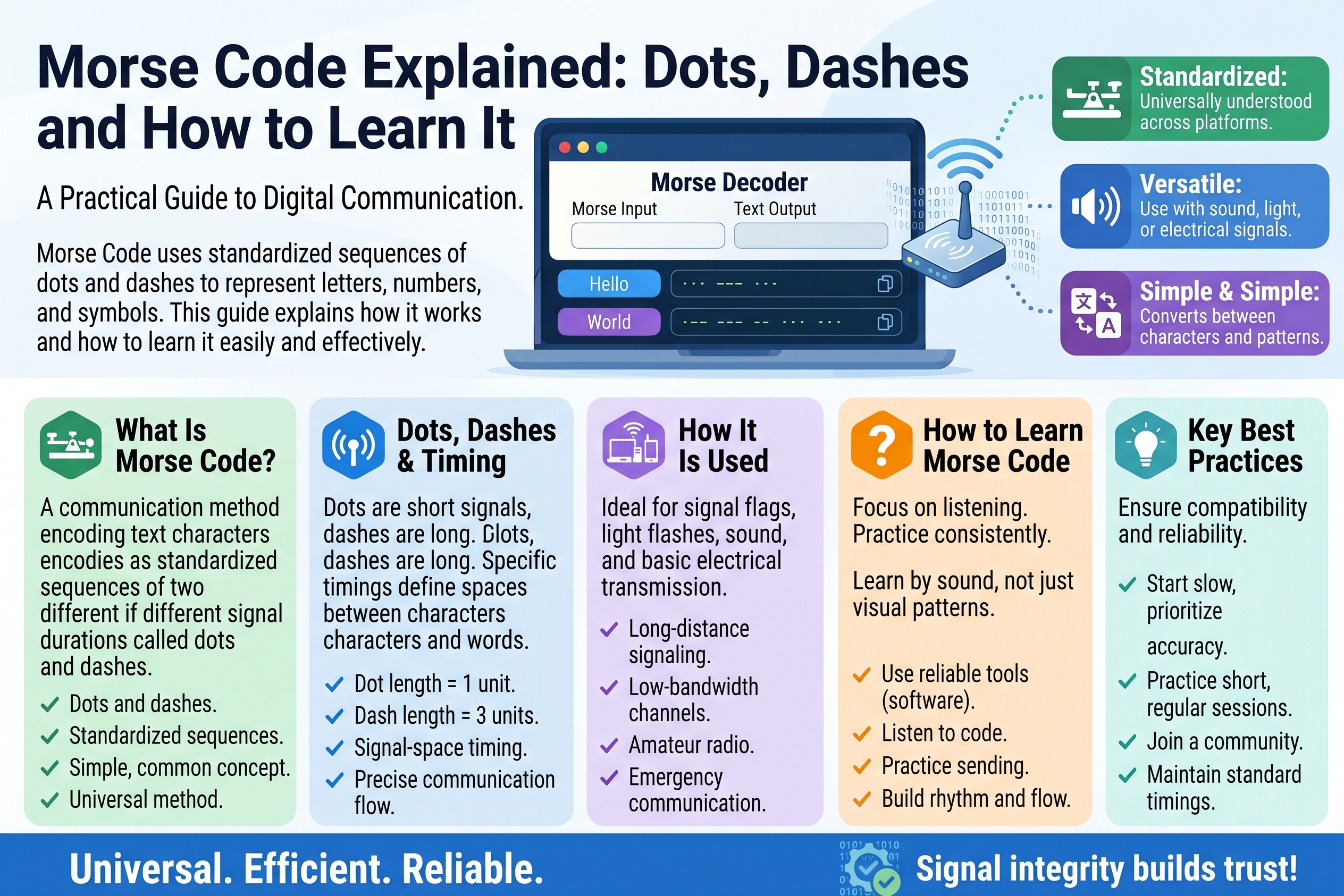
Morse Code Explained: Dots, Dashes and How to Learn It
Three short beeps, three long beeps, three short beeps. Even if you have never studied it, you probably recognize SOS — the most famous distress signal in the world. That pattern of dots and dashes is Morse code, a system for encoding text as a series of short and long signals that has been carrying messages across wires, radio waves, and even blinking lights for nearly two centuries.
Morse code looks like a relic, but it is still actively used by amateur radio operators, pilots, and sailors — and it remains one of the most satisfying things a curious beginner can learn. Here is how it works, why the timing matters as much as the symbols, and a practical path to learning it yourself.
A Quick History: From Telegraph Wires to Radio Waves
In the 1830s, American inventor Samuel Morse and his partner Alfred Vail needed a way to send messages over the new electrical telegraph. Their solution, first demonstrated publicly in 1844 with the famous message "What hath God wrought" sent from Washington to Baltimore, encoded each letter as a pattern of short and long electrical pulses.
The original American Morse code was later refined into International Morse code, standardized in 1865, which is the version still used today. Cleverly, the most common letters got the shortest codes — E is a single dot, T is a single dash — an early form of data compression designed around the frequency of letters in English.
When radio arrived, Morse code adapted effortlessly: the electrical pulses became bursts of radio signal, then beeps a listener could decode by ear. For decades it was the backbone of maritime communication — the Titanic's distress calls went out in Morse — and it remained a licensing requirement for amateur radio operators in many countries until the early 2000s.
How Morse Code Actually Works
At its heart, Morse code has only two symbols:
- Dot (·) — a short signal, one time unit long
- Dash (−) — a long signal, three time units long
But the symbols alone are not enough. Morse code is as much about timing and spacing as about dots and dashes. The rules, measured in units where one unit is the length of a dot:
Dot:                    1 unit of signal
Dash:                   3 units of signal
Gap between dots/dashes within one letter: 1 unit of silence
Gap between letters:    3 units of silence
Gap between words:      7 units of silence
This timing is what lets a listener tell letters apart. Without the gaps, ···−−−··· (SOS) would be an indistinguishable stream of nine signals. The pauses are part of the message — which is why learning Morse by ear, as rhythm, works far better than memorizing pictures of dots and dashes.
The Morse Code Alphabet
Here is the complete International Morse code for letters. Read each as a rhythm — "di-dah" rather than "dot-dash" — and it starts to feel like music:
A ·−      N −·        0 −−−−−
B −···    O −−−       1 ·−−−−
C −·−·    P ·−−·      2 ··−−−
D −··     Q −−·−      3 ···−−
E ·       R ·−·       4 ····−
F ··−·    S ···       5 ·····
G −−·     T −         6 −····
H ····    U ··−       7 −−···
I ··      V ···−      8 −−−··
J ·−−−    W ·−−       9 −−−−·
K −·−     X −··−
L ·−··    Y −·−−
M −−      Z −−··
Notice the design logic: E (·) and T (−), the most frequent letters in English, are the shortest. Common letters like A, I, N, and S get two or three symbols, while rare letters like Q, X, Y, and Z get four. Every code was engineered for speed.
Common punctuation has codes too: period is ·−·−·−, comma is −−··−−, and question mark is ··−−··.
Special Signals: Prosigns and SOS
Beyond letters, Morse code includes prosigns — procedural signals sent as single units without gaps between their letters:
- SOS (···−−−···) — the international distress signal. Despite the myth, it does not stand for "Save Our Souls"; it was chosen purely because the pattern is unmistakable and easy to send.
- 73 (−−··· ···−−) — "best regards," still used by ham radio operators to sign off.
- 88 (−−−·· −−···) — "love and kisses," a warm sign-off between operators.
- AR (·−·−·) — end of message. SK (···−·−) — end of transmission.
These compact signals show Morse at its most efficient: entire phrases compressed into a few beats.
How to Learn Morse Code: Practical Tips
Memorizing the chart by staring at it barely works. These methods do:
Learn by sound, not by sight. From day one, associate each letter with its rhythm — the pattern of short and long tones — rather than a visual arrangement of dots and dashes. Operators copy code at 20+ words per minute by hearing letter-shapes, not by counting.
Use the Koch method. Instead of learning all letters slowly, the Koch method starts with just two letters at full speed and adds a new one only when you recognize the current set with 90% accuracy. It feels slow for a week, then accelerates dramatically. Free trainers like LCWO.net implement it.
Practice in short daily sessions. Fifteen focused minutes beats a two-hour weekend cram. Morse is a motor-auditory skill like touch typing; consistency builds the neural pathways.
Start receiving before sending. Decoding trains your ear; keying (transmitting) comes naturally afterward. Listen to slow Morse podcasts or apps during commutes.
Learn the rhythm words. Mnemonics help early on: the rhythm of "di-di-di-dah-dit" sticks better than "···−·". Many learners hum the patterns.
Try apps and trainers. Morse Mania, IZ2UUF's trainer, and LCWO.net are popular free options. Within a few weeks of daily practice, most learners copy 5–10 words per minute; with months of practice, 15–20 is realistic.
Where Morse Code Is Still Used Today
Morse is far from dead:
- Amateur (ham) radio — CW (continuous wave) Morse remains one of the most popular operating modes. Its narrow signal cuts through noise and weak conditions where voice fails, letting operators contact the far side of the planet with a few watts of power.
- Aviation — navigational beacons broadcast their identifier letters in Morse so pilots can confirm they are tuned to the right station.
- Maritime — signal lamps still flash Morse between ships when radio silence is required.
- Accessibility — people with severe motor impairments have used Morse-based switches to communicate, since it needs only a single reliable muscle movement.
- Emergency preparedness — a flashlight, a whistle, or even tapping on a wall can send SOS when nothing else works. It is the lowest-tech long-distance communication ever invented.
Frequently Asked Questions
How long does it take to learn Morse code? With 15 minutes of daily practice using the Koch method, most people recognize the full alphabet within 3–4 weeks and reach a usable 10–15 words per minute within a few months.
Is Morse code still required for a ham radio license? Not in most countries — the requirement was dropped internationally in 2003. But a huge community of operators still uses it voluntarily because it is effective and fun.
What is the fastest Morse code ever sent? Skilled operators exceed 60 words per minute in competitions, and historical telegraphers reportedly reached similar speeds. For context, conversational Morse runs around 15–25 words per minute.
Can I use Morse code on my phone? Yes — several apps turn your flashlight or screen into a Morse transmitter, and keyboards exist that accept Morse input. It is a novelty for most, but a genuine accessibility tool for some.
Key Takeaways
- Morse code encodes text as short (dot) and long (dash) signals, with precise timing gaps between symbols, letters, and words.
- Frequent letters got the shortest codes — E is one dot, T is one dash — making it an early form of data compression.
- SOS (···−−−···) was chosen for its unmistakable pattern, not as an abbreviation.
- Learn by ear using the Koch method and short daily sessions, not by memorizing the chart visually.
- Morse is still actively used in ham radio, aviation beacons, maritime signaling, and accessibility tools.
Conclusion
Morse code is one of humanity's most elegant inventions: an entire written language compressed into long and short pulses, decodable by ear, by eye, or by touch, with no technology more complex than something that can be turned on and off. Whether you learn it for amateur radio, for emergency preparedness, or simply for the pleasure of hearing language as rhythm, those dots and dashes connect you to nearly two hundred years of people sending messages through the dark. Start with E and T — a sind you are already on your way.
Related Articles
Related Articles
- Binary Numbers Explained: How Computers Count
- Number Bases Explained: Binary, Octal, Decimal, Hexadecimal
- Test Data and Fake Data: A Developer's Guide
- Barcodes: How They Work and Why They Matter
- LF vs CRLF: Line Endings Explained
Try Our Free Tools
Try Our Free Tools