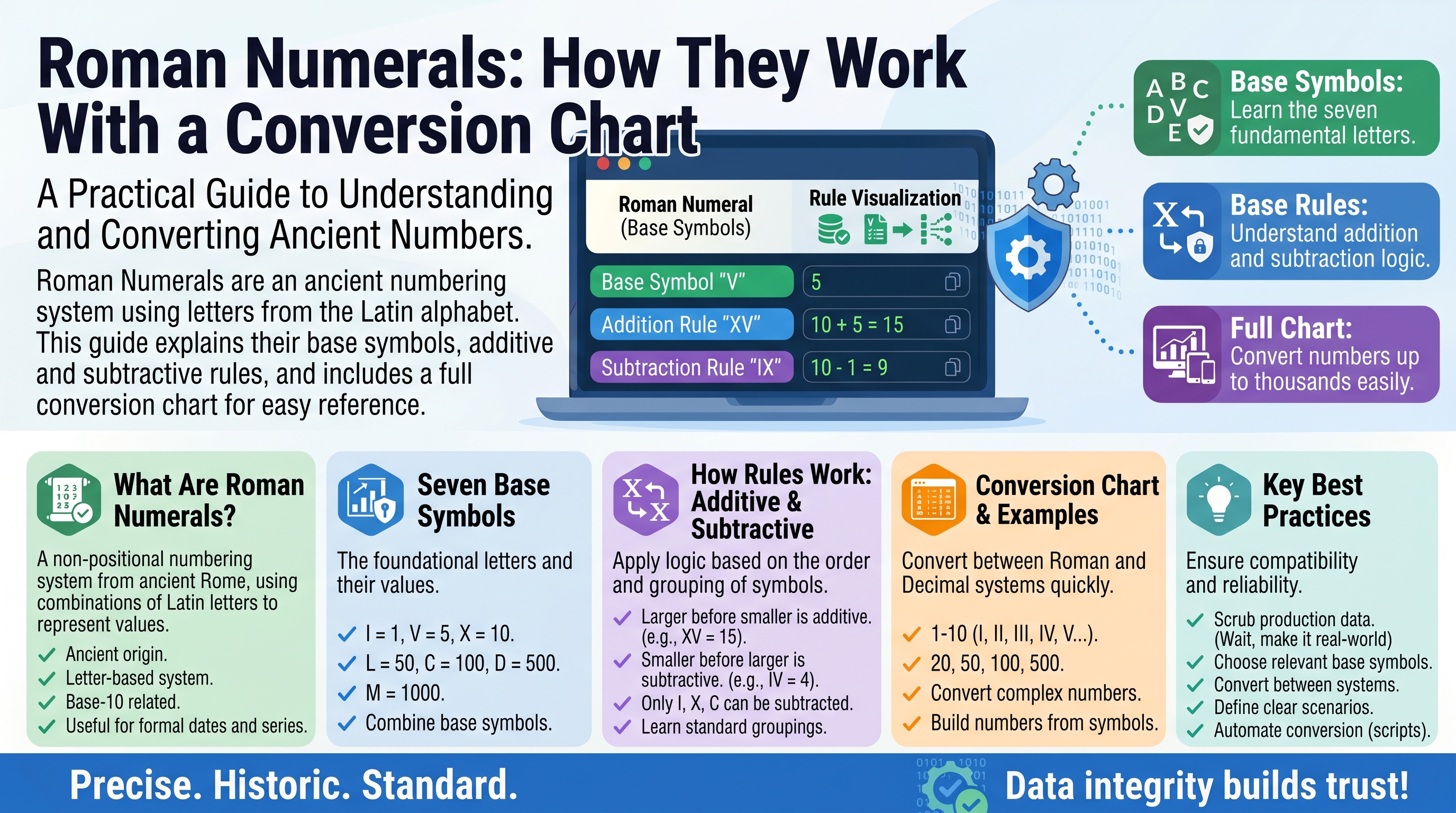
Roman Numerals: How They Work With a Conversion Chart
Roman numerals still show up everywhere — on clock faces, book chapters, movie sequels, building cornerstones and the Super Bowl. They look mysterious, but the whole system runs on just seven letters and a handful of rules. This guide teaches you to read and write Roman numerals confidently, with a full conversion chart.
The Seven Symbols
The entire Roman numeral system is built from seven letters:
I = 1
V = 5
X = 10
L = 50
C = 100
D = 500
M = 1000
That is it. Every Roman numeral you will ever see — from III to MMXXVI — is some combination of these seven symbols.
Rule 1: Add Values Left to Right
Symbols are generally written from largest to smallest, and you add them up:
VI   = 5 + 1       = 6
XV   = 10 + 5      = 15
LX   = 50 + 10     = 60
CL   = 100 + 50    = 150
MD   = 1000 + 500  = 1500
So far, simple addition. The twist comes with the next rule.
Rule 2: The Subtraction Principle
To avoid writing four identical symbols in a row, the Romans placed a smaller numeral before a larger one to subtract:
IV   = 5 − 1       = 4      (not IIII)
IX   = 10 − 1      = 9      (not VIIII)
XL   = 50 − 10     = 40     (not XXXX)
XC   = 100 − 10    = 90     (not LXXXX)
CD   = 500 − 100   = 400    (not CCCC)
CM   = 1000 − 100  = 900    (not DCCCC)
Only specific subtractions are allowed — a smaller value may only precede the next one or two higher denominations:
- I subtracts only from V and X (IV = 4, IX = 9)
- X subtracts only from L and C (XL = 40, XC = 90)
- C subtracts only from D and M (CD = 400, CM = 900)
You will never see "IL" for 49 (that is XLIX) or "XM" for 990 (that is CMXC).
Rule 3: No More Than Three in a Row
The same symbol never repeats more than three times:
- III = 3 ✓, but IIII for 4 ✗ (use IV)
- XXX = 30 ✓, but XXXX for 40 ✗ (use XL)
- CCC = 300 ✓, but CCCC for 400 ✗ (use CD)
V, L and D are never repeated at all — there is no "VV" for 10 (that is X).
Reading Roman Numerals: Step by Step
Work left to right. If a symbol is smaller than the one after it, subtract it; otherwise, add it.
Example — MCMXCIV (a classic tricky one):
M    = 1000                          → 1000
CM   = 1000 − 100 = 900              → 1900
XC   = 100 − 10 = 90                 → 1990
IV   = 5 − 1 = 4                     → 1994
MCMXCIV = 1994. Try another: MMXXVI = 1000 + 1000 + 10 + 10 + 5 + 1 = 2026.
Writing Numbers as Roman Numerals
Break the number into thousands, hundreds, tens and ones, then convert each part:
Example — 2026:
2000 → MM
20   → XX
6    → VI
Result: MMXXVI
Example — 1984:
1000 → M
900  → CM
80   → LXXX
4    → IV
Result: MCMLXXXIV
Example — 444 (uses every subtraction pair):
400 → CD
40  → XL
4   → IV
Result: CDXLIV
Roman Numeral Conversion Chart (1–100)
1 I        11 XI       21 XXI      31 XXXI     41 XLI      51 LI
2 II       12 XII      22 XXII     32 XXXII    42 XLII     52 LII
3 III      13 XIII     23 XXIII    33 XXXIII   43 XLIII    53 LIII
4 IV       14 XIV      24 XXIV     34 XXXIV    44 XLIV     54 LIV
5 V        15 XV       25 XXV      35 XXXV     45 XLV      55 LV
6 VI       16 XVI      26 XXVI     36 XXXVI    46 XLVI     56 LVI
7 VII      17 XVII     27 XXVII    37 XXXVII   47 XLVII    57 LVII
8 VIII     18 XVIII    28 XXVIII   38 XXXVIII  48 XLVIII  58 LVIII
9 IX       19 XIX      29 XXIX     39 XXXIX    49 XLIX     59 LIX
10 X       20 XX       30 XXX      40 XL       50 L        60 LX
61 LXI     71 LXXI     81 LXXXI   91 XCI
62 LXII    72 LXXII    82 LXXXII  92 XCII
63 LXIII   73 LXXIII   83 LXXXIII 93 XCIII
64 LXIV    74 LXXIV    84 LXXXIV  94 XCIV
65 LXV     75 LXXV     85 LXXXV   95 XCV
66 LXVI    76 LXXVI    86 LXXXVI  96 XCVI
67 LXVII   77 LXXVII   87 LXXXVII 97 XCVII
68 LXVIII  78 LXXVIII  88 LXXXVIII 98 XCVIII
69 LXIX    79 LXXIX    89 LXXXIX  99 XCIX
70 LXX     80 LXXX     90 XC      100 C
Key Milestones
500  → D          1000 → M
2024 → MMXXIV     2025 → MMXXV
2026 → MMXXVI     2000 → MM
1776 → MDCCLXXVI  1969 → MCMLXIX
Where You Still See Roman Numerals
- Clock faces — traditionally IIII instead of IV for 4 (a centuries-old clockmaker convention)
- Book chapters and outlines — Chapter XII, section III
- Movie sequels — Rocky II, Super Bowl LX
- Monarchs and popes — Elizabeth II, Louis XIV
- Building cornerstones and copyright dates — MCMLXXXIV on a film's credits
- Chemistry and music theory — oxidation states, chord analysis
Common Mistakes to Avoid
- IIII for 4 — always IV (except on traditional clock faces, which deliberately break the rule)
- IL for 49 — not allowed; 49 is XLIX
- Repeating V, L or D — VV is never correct; use X
- More than three repeats — XXXX is wrong; use XL
- Zero — the Romans had no symbol for zero at all
Key Takeaways
- Seven symbols: I(1), V(5), X(10), L(50), C(100), D(500), M(1000).
- Add left to right; subtract when a smaller value precedes a larger one (IV = 4).
- Subtraction pairs are fixed: IV, IX, XL, XC, CD, CM — nothing else.
- Never repeat a symbol more than three times; never repeat V, L or D.
- To convert: split into thousands/hundreds/tens/ones and convert each part.
Frequently Asked Questions
How do you write 2026 in Roman numerals? MMXXVI — MM (2000) + XX (20) + VI (6).
Why do clocks use IIII instead of IV? Tradition. Clockmakers have used IIII for the 4 o'clock position for centuries — theories range from visual symmetry with VIII on the opposite side to a story about a king demanding it. Modern clocks follow the convention.
What is the largest number you can write in Roman numerals? With standard symbols, 3,999 (MMMCMXCIX). Larger values need a vinculum — a bar over the numeral meaning ×1000 — but that is rarely used today.
Did the Romans really have no zero? Correct — their number system had no zero and no place value, which is one reason Roman arithmetic was cumbersome and Arabic numerals eventually replaced them for calculation.
Conclusion
Roman numerals are far simpler than they look: seven letters, add them up, and subtract when a small letter sits before a big one. With the chart above and the three rules, you can decode anything from a clock face to a movie copyright date. Next time you spot MCMLXXXIV in film credits, you will read it as 1984 without a second thought.
Related Articles
Related Articles
- Binary Numbers Explained: How Computers Count
- Exchange Rates Explained: How Currency Conversion Works
- KB, MB, GB, TB: Data Storage Units Explained
- DPI vs Pixels: What's the Difference
- Aspect Ratios Explained: 16:9, 4:3, 1:1 and More
- Number Bases Explained: Binary, Octal, Decimal, Hexadecimal